
Explained Simply · A Free Family Guide
ALS, Explained Simply
Written and reviewed by Halston Juracka, RN-BSN, Certified Brain Injury Specialist and Kayla Juracka, RN-BSN · Updated August 2026
If someone you love was just told they have ALS, this page is for you. No jargon, no scare tactics, and nothing you need a medical degree to understand. Just what ALS actually is, what it changes, what it does not change, and what helps, written the way we would explain it sitting at your kitchen table.
A free two-page version of this guide to print, share, or bring to an appointment.
Written by Two Registered Nurses · Plain Words, Real Sources · Free to Print & Share
What is ALS?
ALS stands for amyotrophic lateral sclerosis. Some people know it as Lou Gehrig's disease. It affects special nerve cells called motor neurons. These are the cells that carry movement messages from the brain down to the muscles. In ALS, those nerve cells slowly stop working and die. The muscles are still there and still willing. But the messages telling them to move stop arriving, so over time the muscles get weaker.
ALS is not contagious. You cannot catch it and you cannot give it to anyone. In about nine out of ten people, it does not run in the family. About 5,000 people in the United States learn they have ALS each year, most often between the ages of 55 and 75. It was not caused by something you or your loved one did wrong.
Picture It This Way
Think of the body like a company. The brain is headquarters. The nerves are the phone lines. The muscles are the workers. In ALS, headquarters is still open and still full of good ideas. The workers still want to work. But the phone lines stop carrying calls. The orders never arrive, so the workers slowly stop being used, and muscles that are not used grow weak. The problem was never the person inside. It is the phone lines.
.jpeg)
Headquarters is fine. The workers are fine. The phone lines are the problem.
What stays the same with ALS?
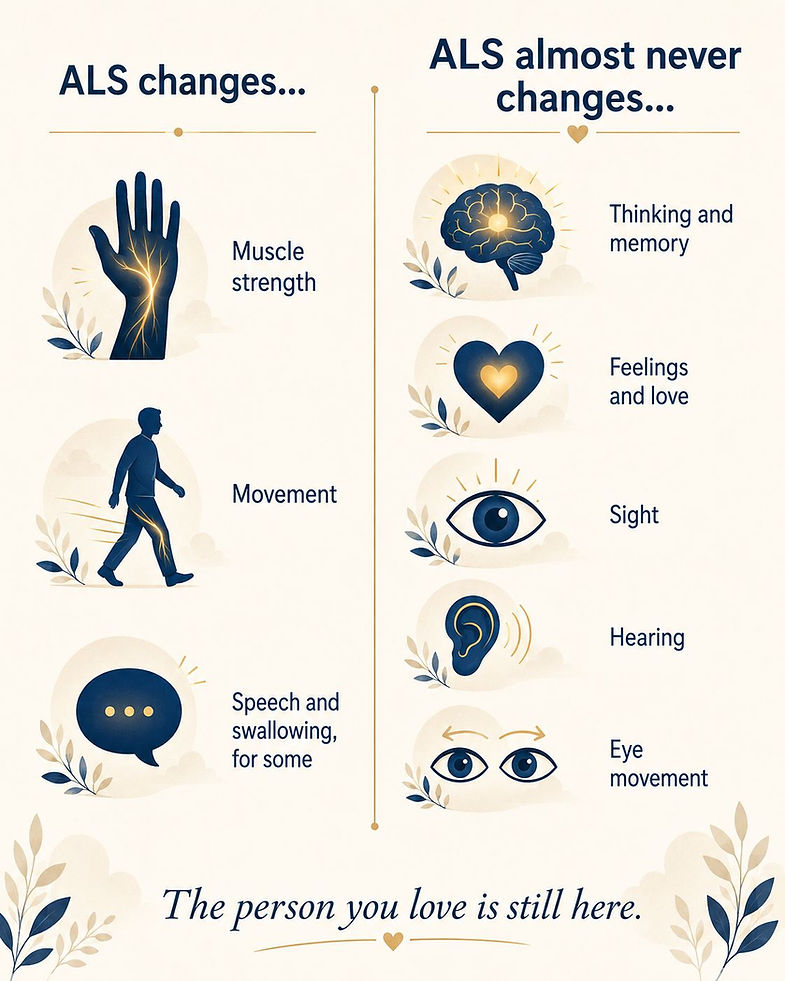
This is the part of the conversation families need most, and the part doctors often run out of time to say. ALS takes muscle strength. It almost never takes the person.
For most people with ALS, thinking and memory stay intact. Feelings stay. Love stays. Humor stays. Sight and hearing stay. The sense of touch stays, which means a held hand still feels like a held hand. Even late in the illness, the eyes usually still move, which is why many people with ALS eventually speak with their eyes using special computers, and say everything they mean to say.
Your person can still hear you in the room. Still follows the conversation. Still notices when someone talks over them or about them. So talk to them, not around them. Ask their opinion. Tell them the news and the gossip. A small number of people with ALS do notice changes in thinking or behavior, and their care team will help if that happens. But the rule that holds for nearly every family we have ever met is this one:
ALS changes what the body can do. It almost never changes who the person is.
.jpeg)
What are the first signs of ALS?
ALS usually starts small, and it usually starts on one side of the body. It does not start with pain. It starts with weakness.
For many people the first signs show up in a hand, an arm, or a leg: a grip that keeps dropping the coffee cup, a foot that catches on the curb, tripping or stumbling for no clear reason, handwriting that changes, or muscles that twitch and cramp. For others it starts in the mouth and throat: speech that sounds slurred or slow, or food and pills that are harder to swallow than they used to be.
Here is what we want every family to hear clearly: these signs have many possible causes, and most of them are not ALS. A pinched nerve, a vitamin problem, a thyroid problem, and plenty of other treatable things can look similar at first. There is no single test for ALS. Doctors diagnose it by examining the person, running tests, and carefully ruling everything else out, which is why the diagnosis often takes months and usually involves a neurologist. If you are seeing these signs, do not sit at home and search the internet at 2 a.m. Get them to a doctor and ask directly whether a neurologist should take a look.
What will change over time?
The honest answer: weakness spreads. Muscles that are strong today will slowly get weaker, and over time that reaches walking, dressing, speech, swallowing, and eventually the muscles that power breathing.
But the honest answer also includes this: every person's pace is different, and no chart can tell you your person's pace. Some people decline over a few years. About one in ten lives ten years or more. Changes usually come gradually rather than overnight, and that matters, because it gives families time to get ahead of each stage instead of being surprised by it. The families who do best are not the ones who fight the hardest against equipment and help. They are the ones who accept each tool a little before it is needed, so nothing ever becomes an emergency.
Picture It This Way
Go back to the company. The phone lines go quiet one street at a time, not all at once. When the lines to one neighborhood go down, the company does not close. It reroutes: a wheelchair does what legs did, a speech device does what the voice did, a breathing machine helps the chest do its work at night. Headquarters stays open through all of it. The plans, the personality, the memories, the love: still at their desk, still running the company.
Is there treatment for ALS?
There is no cure yet. But "no cure" does not mean "nothing helps," and families deserve to know the difference.
There are FDA-approved medicines. Riluzole and edaravone can slow the disease down for some people. For a rare inherited form of ALS, a newer medicine called tofersen targets the gene itself. Your neurologist will talk through which ones fit, and whether any research trials are open, because ALS research is moving faster right now than at any point in history.
And here is the treatment fact we wish were printed on the first page of every diagnosis packet: the strongest proven help for ALS is not a pill. It is a team. Multidisciplinary ALS clinics bring the neurologist, breathing specialists, nutrition, speech, physical and occupational therapy, and equipment experts into one room around one person. Research shows that people cared for by these teams live longer and live better than people managed visit by visit. If you do only one thing after reading this page, get connected to an ALS clinic.
When should you call the doctor, and when is it 911?
Call the ALS clinic or doctor for changes that build over days and weeks. Call 911 for anything that threatens breathing, right now. Here is the split, plainly.
Call the Doctor or ALS Clinic Soon
Changes worth a call this week, not a wait until the next appointment.
-
New weakness, or more falls and near-falls than before
-
Coughing or choking with meals more than before
-
Eating less, or losing weight without trying
-
Speech that is harder to understand than last month
-
Morning headaches, new daytime sleepiness, or waking at night feeling short of breath
-
Feeling down, anxious, or worn thin. That includes the caregiver.
Call 911 Right Away
Do not wait, do not drive yourselves, do not call the clinic first.
-
Severe trouble breathing, or breathless even at rest
-
Choking that will not clear
-
Cannot swallow fluids or medicines at all
-
Lips or face turning bluish or gray
-
New confusion, or hard to wake up
-
A fall with a hit to the head, or a possible broken bone
When you call 911 for someone with ALS, say the words "my family member has ALS, a breathing muscle disease" early in the call. It changes what the crew brings to the door and what the emergency room does first.
What should families set up at home?
The single best habit in ALS care is setting things up a little before they are needed. Here is where we tell families to start.
Set Up Early, Not After a Fall
✓
Clear the paths. Remove loose rugs, cords, and clutter from walkways. Falls are the enemy.
✓
Make the bathroom safe. Grab bars, a shower chair, and a raised toilet seat, installed before the first close call.
✓
Plan for one floor. If the bedroom is upstairs, start thinking now about moving life to the main floor.
✓
Choose firm chairs with arms. Low, soft couches quietly steal independence months early.
✓
Bank the voice. Record your person reading and talking now, while speech is easy. Speech devices can later speak in their own voice.
✓
Get equipment through the clinic. The ALS team and local chapters can arrange walkers, wheelchairs, and lifts, often on loan at no cost.
✓
Save energy on purpose. Weak muscles tire fast. Spend energy on what matters, not on chores anyone can do.
✓
Have the big conversations early. Care wishes, paperwork, and who decides what, talked through calmly while talking is still easy.
Your ALS clinic's occupational and physical therapists will walk your actual home with you. Take them up on it.
Is ALS connected to military service?
Yes, and this section could be worth a great deal to your family, so please do not skip it.
People who served in the military are about twice as likely to develop ALS as people who never served. No one fully knows why, and it holds across branches and eras of service. Because the connection is so consistent, the federal government made a rule about it.
For Veterans and Their Families
The VA treats ALS as a service-connected condition. Under federal rule 38 CFR 3.318, a veteran with ALS who served 90 days or more of continuous active duty is presumed to have a service-connected illness. The veteran does not have to prove the service caused it.
That can mean monthly disability compensation, VA health care, wheelchairs and equipment, grants to modify the home and vehicle, and support for the spouse. Many families never claim it because no one told them. File with the VA right away after diagnosis. A Veterans Service Officer (VSO) will prepare the claim with you for free. Never pay anyone to file a VA claim.
Where can Las Vegas families turn?
You do not have to build this support system from scratch. Most of it already exists here in the valley.
The Cleveland Clinic Lou Ruvo Center for Brain Health in downtown Las Vegas has a multidisciplinary ALS clinic, the team-based care described above, close to home. ALS of Nevada supports local families with education, support groups, and equipment loans. Nationally, the ALS Association and I AM ALS connect families to research, resources, and other people walking the same road. Veterans and their families should also connect with the VA Southern Nevada Healthcare System and a Veterans Service Officer to start the claim described above.
And when a family needs more hands and more eyes at home, that is the work our practice does: nurse-built support for daily life that works alongside the clinic's team, never in place of it. If you are starting to think about what help at home actually costs, we keep an honest, current guide to that too. No pressure and no sales script. If it helps to talk through what you are seeing with a nurse for fifteen minutes, that is free, and it is enough time to leave you with a clearer next step.
Free to print, copy, and share with patients, clients, families, and caregivers.
More in This Series
ALS Explained Simply · Heart Failure Explained Simply · Stroke Explained Simply · Every "Explained Simply" guide is free, written by the same two nurses, and built to be shared.
HJ
About the owners
Halston Juracka, RN-BSN, CBIS and Kayla Juracka, RN-BSN are the registered-nurse owners of Apex Home Nursing Services, a premium private-pay home care agency serving Summerlin, Henderson, and the greater Las Vegas valley. Halston is a Certified Brain Injury Specialist and nurse educator. They founded Apex to give referral partners a clinically serious, reliable resource and to give families nurse-led care that actually keeps people safe at home.
Sources
National Institute of Neurological Disorders and Stroke (NINDS). Amyotrophic Lateral Sclerosis (ALS) Fact Sheet. 2024.
Centers for Disease Control and Prevention. National ALS Registry, prevalence and incidence reporting. MMWR.
Paganoni S, et al. Multidisciplinary clinic care in ALS and its association with survival and quality of life. (Peer-reviewed literature on multidisciplinary ALS care.)
38 CFR §3.318. Presumptive service connection for amyotrophic lateral sclerosis. U.S. Department of Veterans Affairs.
References
-
U.S. Centers for Disease Control and Prevention. Facts About Falls, Older Adult Fall Prevention, 2026. cdc.gov/falls
-
Reducing Hospital Readmissions, StatPearls, NCBI, 2024; and 30-day readmission analyses among older adults. ncbi.nlm.nih.gov
-
Genworth and CareScout 2024 Cost of Care Survey; Nevada cost data. payingforseniorcare.com/nevada
This guide is general educational information, not medical, legal, or financial advice. Apex Home Nursing Services is an RN-owned, private-pay personal care agency in Las Vegas, Nevada. Registered nursing services, where applicable, are provided by the RN owners under their own Nevada licenses, coordinated by, not provided by, the agency.